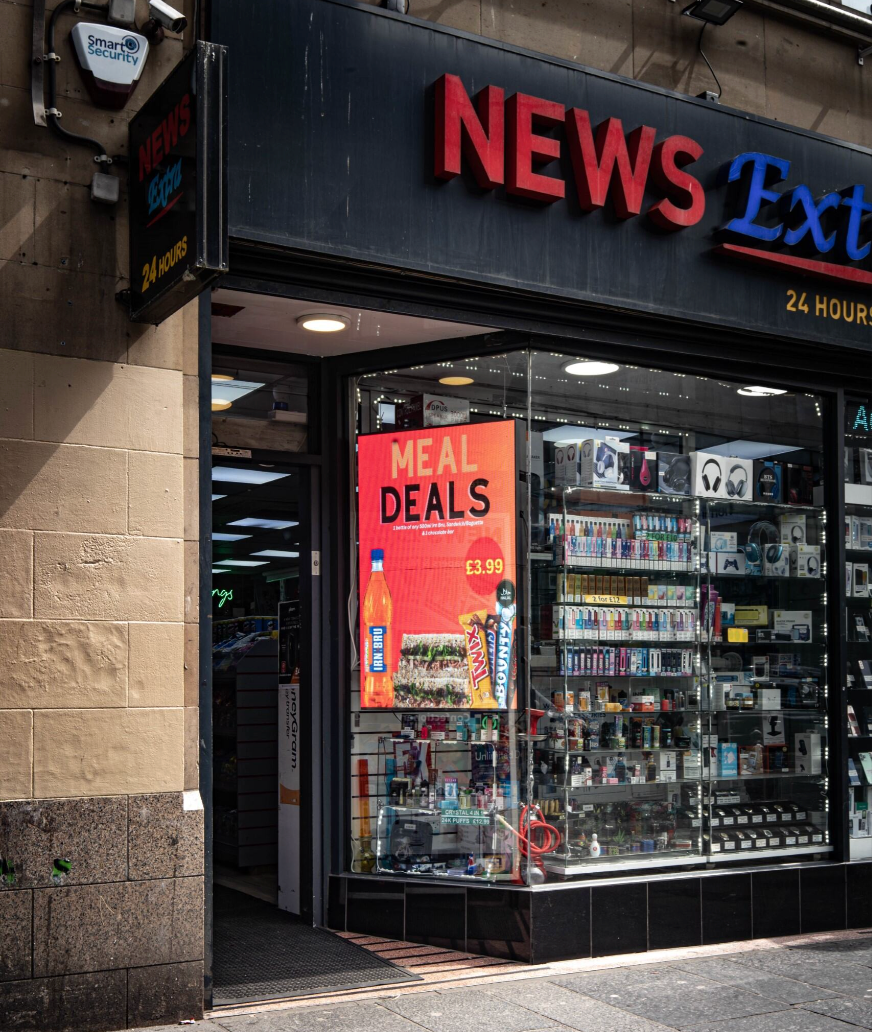
Retail Digital Screens in High-Footfall Environments: Why Mount Type Determines ROI More Than Resolution
Retail Digital Screens in High-Footfall Environments: Why Mount Type Determines ROI More Than Resolution
A 4K display running vibrant promotional content is worthless if it's angled at the ceiling, obscured by a pillar, or positioned at eye level on a wall that foot traffic walks parallel to — never facing. Yet this is one of the most common and costly mistakes retailers make when deploying digital signage.
The conversation in retail almost always centres on resolution, brightness, and content quality. Those things matter. But if your mount type is wrong for your environment, you're effectively broadcasting to no one. Before you invest in premium hardware or content production, the physical positioning of your screens deserves far more strategic attention than it typically receives.
Why Screen Placement Outweighs Panel Specs in Busy Retail Environments
Resolution and brightness are measurable. They appear on spec sheets and are easy to compare. But audience capture — the percentage of passing shoppers who actually see your screen — is determined almost entirely by angle, height, and orientation relative to traffic flow.
In high-footfall retail spaces, shoppers move quickly. A screen mounted flat against a side wall at standing eye level may only be visible to customers who happen to stop directly in front of it. Change that to a ceiling-mounted display angled downward toward a queue or a junction point, and you transform the same panel into something that commands attention from multiple directions simultaneously.
This is why mount type is a business decision, not a technical afterthought. The right mounting hardware determines how many people see your retail digital screens, for how long, and from what angle — all of which directly affect whether your signage investment generates any measurable return.
Rank your Shopify store on Google, get cited by ChatGPT and Claude. 20 free SEO posts a month. Install EmergeRank.
Get EmergeRank free →The Case for Telescopic Ceiling Mounts in Junction and Aisle Environments
The AS94601L Telescopic Ceiling Mount is designed specifically for environments where wall space is limited or where screens need to be positioned above head height to maximise sightlines. In grocery, fashion, and general merchandise retail, ceiling mounting is frequently the superior option at aisle ends, junction points, and checkout approaches.
Ceiling-mounted retail digital screens benefit from a simple advantage: they sit in the natural sightline of shoppers looking ahead or upward while navigating a space. Unlike wall-mounted screens that compete with product displays and shelf-edge signage for horizontal attention, a ceiling-hung display occupies visual space that is largely uncontested.
The telescopic design of the AS94601L allows height adjustment, which is critical in environments with variable ceiling heights or where the screen needs to be lowered to optimise viewing distance for a specific screen size. A 43-inch display mounted at three metres without tilt adjustment becomes very difficult to read at an acute angle — the telescopic element solves this by letting you find the precise drop height that works for your specific environment.
For retailers running a Slimline Digital Poster — available from £410 in sizes from 22" to 55" — ceiling mounting can be transformative. These portrait-format displays, running Android 11 with Ultra HD (4K) resolution and 500 cd/m² brightness, are well suited to aisle-end and junction positioning where portrait orientation aligns naturally with the vertical field of view.
Tilting Wall Mounts and the Problem of Parallel Foot Traffic
The AS0948T Tilting Wall Mount addresses one of the most persistent problems in retail signage deployment: screens that face the correct wall but cannot reach the shoppers walking parallel to it.
In long corridors, department store aisles, and shopping centre walkways, foot traffic often runs perpendicular to the available wall space. A flat wall mount points your screen directly into the path of traffic on the opposite side of the aisle, rather than engaging the people walking closest to it. A tilting mount changes that geometry — rotating the screen downward and, where the bracket allows horizontal pivot, angling it toward approaching traffic rather than those already passing.
This is not a minor refinement. The difference between a fixed flat mount and a properly tilted mount in a corridor environment can determine whether a screen communicates with shoppers approaching from fifteen metres away or only those standing directly in front of it. For promotional content with a call to action — a limited-time offer, a product demonstration, a wayfinding instruction — that reach distance is commercially significant.
The AS0948T is particularly well matched to mid-sized commercial displays. If you're running Ultra High Brightness Window Displays inside your store near glazed partitions or in well-lit areas — available from £1,770 across portrait sizes from 43" to 75" — a tilting mount helps direct that 500 cd/m² brightness precisely where ambient light conditions and traffic flow demand it.
Content Quality and Dwell Time: What Happens After You Get the Angle Right
Once your retail digital screens are correctly positioned and angled, the next variable is how long a viewer actually engages. This is where content design becomes the multiplier on everything you've already done correctly with hardware placement.
In House Content Design from BuyDigitalSignage.co.uk addresses exactly this gap. A display positioned at the ideal angle with the optimal tilt, running a static image or poorly structured content loop, will still underperform. Dwell-time impact — the measure of how long a viewer holds their attention on your screen — is primarily a content problem once placement is solved.
Professionally designed content for digital signage accounts for viewing distance, ambient environment, loop duration, and the specific call to action appropriate for the location. Queue environments need different content pacing from entrance displays. Aisle-end screens require different messaging hierarchies from window-facing units. Getting placement right and content wrong means you've built a high-quality funnel with nothing valuable at the end of it.
Matching Mount Type to Store Format: A Practical Framework
Not every retail environment calls for the same mounting solution. Here's how to think about it:
Entrance and lobby areas: Wall mounts with tilt capability work well here, angled toward foot traffic as it enters. Larger format displays, such as a 55" or 65" panel, benefit from tilt adjustment to maintain readability across the width of the entrance.
Aisle ends and junction points: Ceiling mounts with telescopic drop are typically superior. The downward angle naturally captures shoppers approaching from the aisle, and the overhead position avoids obstruction from product displays.
Checkout and queue environments: Either mount type can work, but the priority here is ensuring the screen is within comfortable reading distance without requiring shoppers to turn their heads significantly. Tilt-adjustable wall mounts at slight downward angles are effective in linear queue configurations.
Shop windows and glazed frontages: Ultra High Brightness Window Displays are purpose-built for these positions, with brightness levels engineered to remain visible in direct daylight. Wall mounting with outward-facing positioning is standard here, but tilt can help direct content toward pedestrians at pavement level rather than at standing eye height inside the store.
FAQ
Q: Does the mount type affect the warranty or performance of my retail digital screens? A: The mount itself does not affect screen warranty, but improper mounting that causes physical stress, overheating from restricted ventilation, or vibration over time can impact panel longevity. Using a mount rated for your specific screen size and weight is essential.
Q: How do I know whether to use a ceiling or wall mount in my store? A: The primary factor is traffic flow direction relative to available fixing surfaces. If your main foot traffic runs parallel to your walls, a ceiling mount angled toward the traffic path will typically outperform a flat wall mount. If traffic approaches a screen head-on, a tilting wall mount is usually sufficient.
Q: Can I use the AS0948T Tilting Wall Mount with a larger format display like a 65" screen? A: Always check the weight and VESA compatibility ratings of any mount against the specific screen you're using. Mount specifications should be confirmed against your chosen display's dimensions and weight before installation.
Q: Is professional content design worth the additional cost for a small retail deployment? A: For a single-screen deployment in a low-dwell environment, basic content may suffice. However, in high-footfall locations where each shopper represents a potential transaction, professionally paced and visually structured content typically recovers its cost quickly through improved engagement and conversion rates at the point of display.
Make Your Signage Investment Work From Every Angle
The resolution of your panel is visible on a spec sheet. The ROI of your retail digital screens is determined in the physical space where your customers actually move, look, and decide. Investing in the right telescopic ceiling mount or tilting wall bracket is not an accessory purchase — it is a core part of your signage strategy.
At BuyDigitalSignage.co.uk, mid-range commercial displays are paired with the mounting hardware and content design services needed to ensure your installation performs rather than merely exists.
Browse the full range of digital signage solutions at BuyDigitalSignage.co.uk and make sure your next screen is positioned to earn its place on your shop floor.