Retail Digital Signage That Actually Converts: Why Screen Placement Beats Screen Size Every Time
Retail Digital Signage That Actually Converts: Why Screen Placement Beats Screen Size Every Time
A 75-inch flagship display bolted to the wrong wall at the wrong height is just an expensive piece of furniture. Walk into almost any high street retailer and you'll find at least one — a premium screen facing the wrong direction, mounted too high for comfortable reading, running a slideshow of promotions nobody pauses to absorb. The hardware budget was substantial. The thinking behind it was not.
This post makes a direct case: the retailers achieving the strongest return from retail digital signage are not the ones spending the most on hardware. They are the ones asking better questions before a single bracket goes into a wall.
The Placement Problem That No One Talks About Enough
Most procurement conversations start with screen size. That instinct is understandable — a larger screen feels like a more serious commitment. But screen size only matters insofar as it suits the viewing distance and dwell time at a specific location in your store.
Consider a narrow entrance corridor with a two-second average walk-through. A 65-inch screen in that space does not give you more impact. It gives you a screen that shoppers are too close to read comfortably, running content that cannot be absorbed before they have already moved past it.
The productive questions are different:
- Where do customers naturally pause?
- How long do they typically dwell at that point?
- What decision are they making at that moment?
- What angle will they approach the screen from?
A 43-inch display mounted at eye level beside a product category they are already browsing, running content timed to a five to eight second read, will convert more reliably than a premium 75-inch screen mounted high on a wall as an afterthought.
Rank your Shopify store on Google, get cited by ChatGPT and Claude. 20 free SEO posts a month. Install EmergeRank.
Get EmergeRank free →Why Retailers Consistently Overspend on Hardware and Underspend on Strategy
The pattern is predictable. A retailer allocates a signage budget, spends the majority of it on the largest screens available, then discovers there is little left for professional installation, content creation, or a content management system. The result is technically impressive hardware running static PowerPoint slides that nobody updates.
The hardware is rarely the weak link. The weak link is almost always one of three things: poor placement, content that does not match the context of where the screen sits, or the absence of any system for keeping that content current and relevant.
A mid-range screen with purposeful content and a sensible content refresh schedule will consistently outperform a flagship display running stale promotions. This is not a controversial position among professionals who install commercial signage for a living. It is simply not the conversation that hardware sales cycles tend to encourage.
Matching the Right Display to the Right Environment
That said, hardware decisions are not irrelevant — they just need to follow placement decisions rather than precede them. Once you know where a screen will live and what it needs to do, choosing the right product becomes considerably more straightforward.
For interior retail environments where footfall passes at close range, the Slimline Digital Poster is a strong mid-range option. Available in portrait sizes from 22 to 55 inches (plus a landscape 22-inch variant), it delivers Ultra HD 4K resolution at 500 cd/m² brightness, running Android 11 via a VA panel. Priced from £410 to £1,350 depending on size, it represents the kind of specification that suits most interior retail use cases without pushing budget into territory that the use case does not justify.
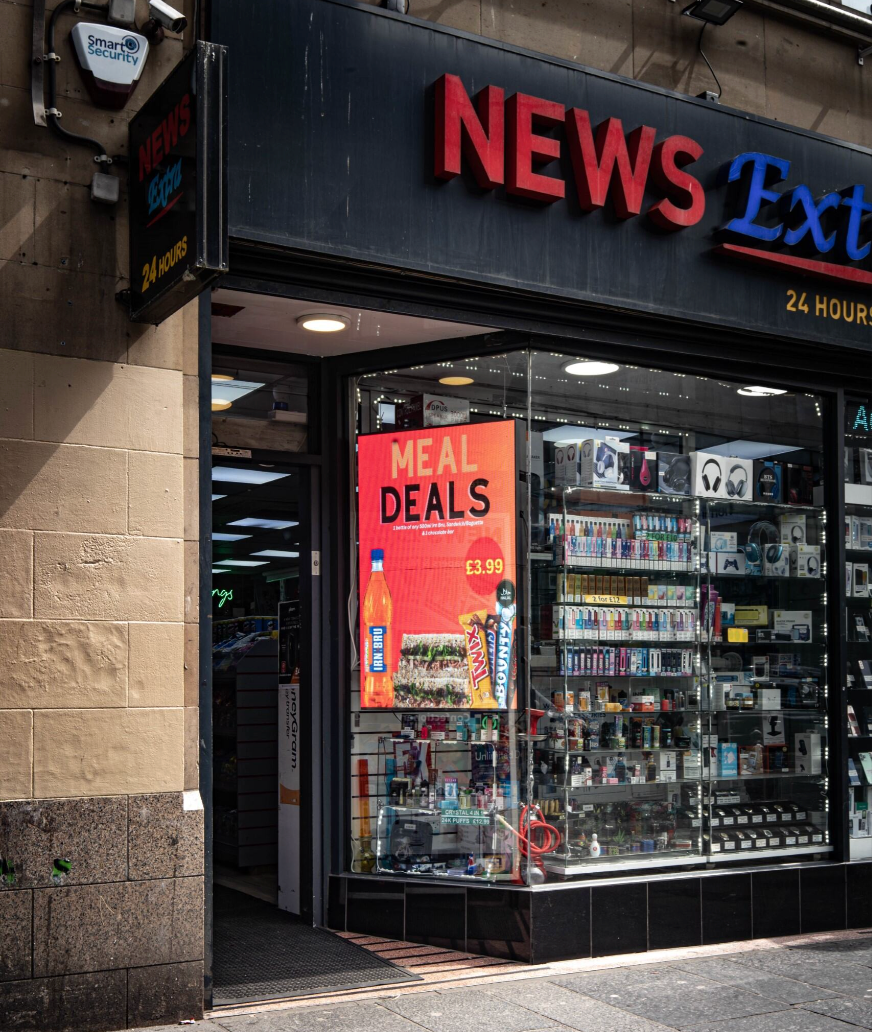
Where the environment changes — specifically where daylight becomes a factor — the hardware requirement changes with it. A window-facing display needs significantly higher brightness than a standard interior screen to remain legible in direct sunlight. For those positions, the Ultra High Brightness Window Displays are purpose-built, available in portrait sizes from 43 to 75 inches (plus landscape 43-inch) and priced from £1,770 to £4,370. These are the right tool for a shop window, estate agent display, or salon frontage — not because of their size, but because of what they are engineered to do in that specific lighting condition.
The principle is consistent: let the location determine the specification, not the other way around.
Content Strategy Is Where Conversion Actually Happens
A screen is a medium. Conversion is determined by the message. This is where retail digital signage investment most commonly breaks down, and it is also where relatively modest additional spend delivers disproportionate returns.
Effective in-store content is not a digital version of a printed poster. It accounts for:
Viewing distance and dwell time. Content designed for a screen beside a checkout queue can carry more detail than content designed for a screen at the entrance. The dwell time is different. The customer's state of mind is different.
The decision being made nearby. A screen beside a premium product category should reinforce value and quality. A screen beside a promotional bay should create urgency. Generic brand content in either position is a wasted opportunity.
Content rotation and relevance. A screen running the same promotion for six weeks is arguably worse than no screen at all — it trains customers to ignore it. A content management system and a realistic schedule for updating creative are not optional extras. They are the mechanism through which placement and hardware decisions pay off.
Outdoor Retail Environments Demand a Different Discipline
For retailers with car parks, forecourts, garden centres, or any customer-facing exterior space, the placement logic holds but the hardware requirements shift considerably.
Outdoor environments introduce weatherproofing, temperature tolerance, and visibility challenges that interior commercial displays are not rated to handle. The Outdoor LCD Displays range addresses this directly — wall-mounted screens designed for commercial outdoor use, available in portrait sizes from 22 to 65 inches, priced from £1,435 to £7,405. High brightness and commercial-grade build quality make these appropriate for situations where a standard interior display would simply fail.
The placement discipline applies here just as it does indoors. An outdoor screen positioned where passing vehicles cannot read it, or mounted at a height that makes pedestrian engagement awkward, is not performing its function regardless of the specification. Site the screen where your customers actually look, and at the height where they naturally focus, before deciding on the size.
A Practical Framework Before You Buy Anything
Before any hardware purchase, work through these steps:
- Map your customer journey. Where do customers enter, pause, browse, and queue? Mark every natural dwell point.
- Assign a purpose to each location. Awareness, product education, promotion, wayfinding — each location should have one clear job.
- Determine viewing conditions. Interior or exterior? Natural light exposure? Typical viewing distance?
- Let those answers dictate the specification. Size, brightness, and orientation should follow from steps one to three.
- Budget for content from the start. Treat content creation and management as a line item, not an afterthought.
Retailers who work through this process — even informally — consistently get more from their signage investment than those who start with a product catalogue and work backwards.
FAQ
Q: Does screen size matter at all for retail digital signage? A: Size matters, but it should be determined by viewing distance and the physical space rather than chosen first. A screen that is too large for the viewing distance is as problematic as one that is too small.
Q: What brightness level do I need for a shop window display? A: Standard commercial displays typically operate around 500 cd/m², which suits interior environments. For window-facing positions exposed to direct sunlight, you need a significantly higher brightness rating. Purpose-built options like the Ultra High Brightness Window Displays are designed specifically for this scenario.
Q: How often should retail digital signage content be updated? A: There is no universal rule, but content that never changes trains customers to ignore it. Aligning your content schedule with promotional cycles, seasonal changes, and new product arrivals is a practical starting point. A content management system makes this significantly easier to maintain consistently.
Q: Can I use an indoor display in a covered outdoor area? A: This depends on the specific environment, but covered outdoor areas often still expose screens to temperature fluctuations, humidity, and ambient light levels that standard interior displays are not rated for. If in doubt, a display rated for outdoor commercial use — such as the Outdoor LCD Displays range — is the safer choice.
Start With Where, Not What
The most valuable shift any retailer can make before investing in signage is moving the first question from what screen should I buy to where will this screen live and what does it need to do there. Hardware follows that answer. So does budget allocation. So does content strategy.
A correctly positioned mid-range display with relevant, regularly updated content will deliver more measurable value than a premium screen placed without purpose. That is not a compromise position. It is simply how effective retail digital signage works.
Browse the full range at BuyDigitalSignage.co.uk — from interior digital posters to outdoor-rated commercial displays — and find the specification that suits what your space actually requires.