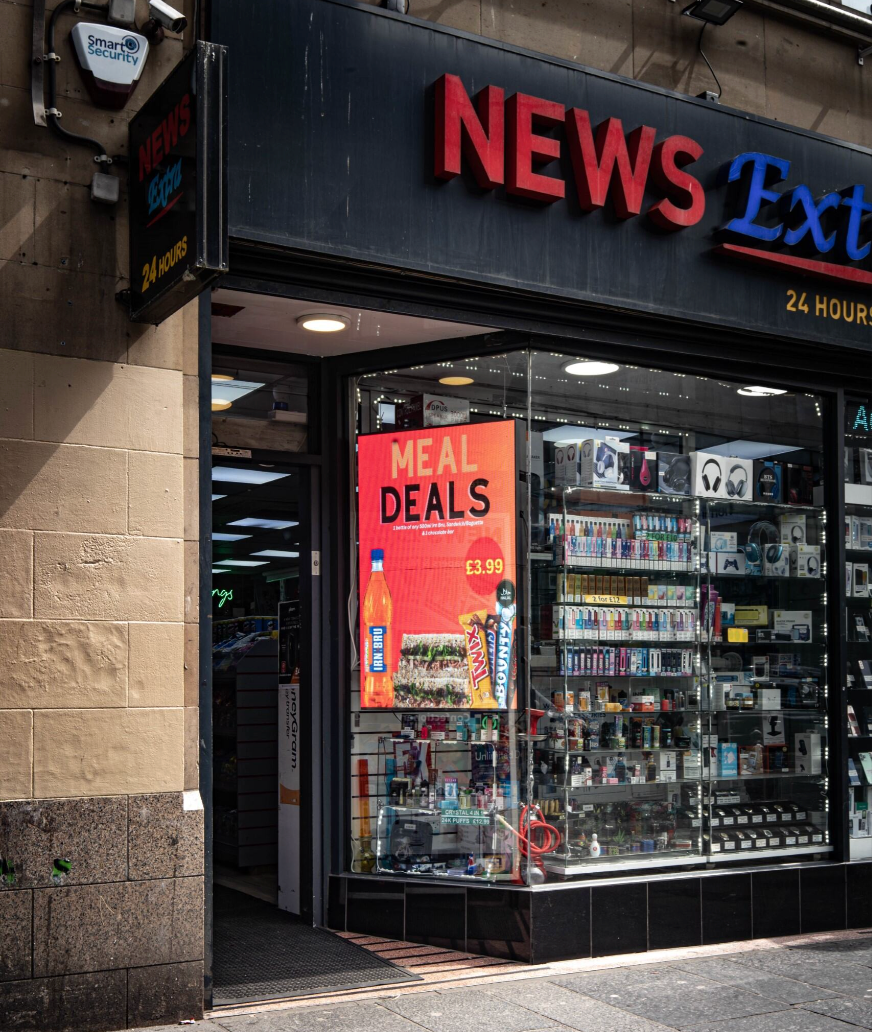
Outdoor Digital Signage for Business
Outdoor Digital Signage for Business: Why Brightness Specs Alone Won't Save Your Display From Failing in 6 Months
Your 2,500-nit display arrives, gets mounted on the shopfront, and looks immaculate on day one. Six months later, the image is washed out, the enclosure has condensation creeping into the corners, and the unit is running hot enough to trigger automatic shutdowns. The screen didn't fail — everything around it did.
This is the conversation most brightness spec sheets never start, and it's costing UK businesses thousands in premature replacements.
Why Outdoor Digital Signage for Business Is More Than a Brightness Number
Nits — the unit used to measure display brightness — dominate outdoor screen conversations because they're easy to compare. But brightness is a single variable in a system with many failure points.
Consider what a screen mounted on a south-facing shopfront actually faces throughout a year: direct UV exposure, sub-zero overnight temperatures in winter, high ambient heat in summer that forces the display into thermal throttling, rain ingress at every seal point, and condensation forming inside the enclosure when temperatures swing rapidly between day and night.
None of those conditions are solved by increasing luminance output. A screen rated at 2,500 nits that's installed in a poorly ventilated enclosure with inadequate IP-rated protection will degrade faster than a well-specified 1,500-nit unit with proper thermal management and sealed ingress protection.
When businesses invest in outdoor digital signage for business, they need to evaluate the full system — not just the panel output.
Rank your Shopify store on Google, get cited by ChatGPT and Claude. 20 free SEO posts a month. Install EmergeRank.
Get EmergeRank free →The Enclosure Problem: Where Most Outdoor Displays Actually Fail
The most common cause of early failure in outdoor commercial displays isn't the panel degrading — it's moisture and heat attacking the components the panel depends on. Power supplies, media players, and connection ports are all vulnerable to the kind of environment that UK weather creates reliably and repeatedly.
IP (Ingress Protection) ratings exist for exactly this reason. A display rated IP65, for example, is fully dust-tight and protected against water jets from any direction. IP56 offers strong water resistance but with slightly less dust protection. The difference matters when a display is mounted near a road with vehicle spray, or on a coastal high street with salt air.
Thermal management is equally critical. Commercial-grade outdoor screens use active or passive cooling systems to maintain safe operating temperatures. Without them, sustained heat causes the panel's backlight to dim permanently over time — so that 2,500-nit spec you paid for becomes a 1,800-nit reality by summer's end, and keeps dropping.
This is precisely where purpose-built commercial enclosures earn their cost. They're not a premium add-on; they're the difference between a three-year asset and a six-month liability.
Mounting Orientation, Viewing Angles, and the Specs Nobody Discusses
Portrait orientation dominates outdoor retail signage, and for good reason — it mirrors the proportions of a standing person, suits menu boards and promotional content, and makes efficient use of narrow wall space on high streets.
But orientation affects more than aesthetics. A portrait-mounted screen faces different heat distribution challenges than a landscape unit. Heat rises, and in a vertically oriented display, the upper portion of the enclosure accumulates more thermal stress. Screens built specifically for portrait commercial deployment account for this — screens repurposed from indoor landscape use typically don't.
The Outdoor LCD Displays from BuyDigitalSignage.co.uk are available in portrait orientation across six sizes — 22", 32", 43", 49", 55", and 65" — with pricing from £1,435 to £7,405. These are LCD wall-mounted screens built for commercial environments including retail, hospitality, and public venues, with high brightness and weatherproof construction designed to handle the conditions described above. The fact that they ship in portrait variants specifically reflects the practical reality of how outdoor retail signage is actually deployed.
Viewing angles are another underappreciated spec. VA panels, for instance, offer strong contrast ratios but can shift colour noticeably at wider angles. If your display is mounted at height and viewed from below, or positioned where foot traffic approaches from an angle, panel technology choices directly affect whether your content reads as intended — or looks washed out and off-colour from three metres away.
Touch Screens Outdoors: The Additional Failure Points Nobody Warns You About
Interactive outdoor displays introduce an entirely new set of durability challenges. Projected Capacitive (PCAP) touch technology is the standard for commercial outdoor touch screens because it works through glass and can handle gloved or wet fingers — but only when the screen is properly specified for outdoor use.
Rain is the obvious challenge. Water on a touchscreen surface can register phantom inputs, making the display unusable in wet conditions unless the touch controller has been calibrated and firmware-configured to filter water contact. Vandalism resistance, UV-stable glass coatings, and anti-reflective treatments all become relevant when a screen is publicly accessible.
The Wall Mounted PCAP Outdoor Touch Screen available on BuyDigitalSignage.co.uk runs Android 11, uses a VA panel with Ultra HD (4K) resolution, and is available in portrait orientation from 22" to 65", priced from £2,040 to £8,710. The VESA 400x400 mounting pattern is a practical detail that matters for installation planning — non-standard mounting points create complications when installers work with third-party bracket systems. These are the specifics that determine whether a deployment runs smoothly, not just whether the screen looks good in a product image.
When Permanent Installation Isn't Possible: Battery-Powered Outdoor Signage
Not every outdoor digital signage deployment suits a fixed wall mount. Pavement locations, temporary promotional spots, seasonal retail setups, and event-based use all require a different approach — one where cabling to the mains isn't practical or permitted.
The Outdoor Digital Battery A-Boards at £2,370 address this directly. Weather-resistant and cable-free, they're designed for businesses that need a portable display solution capable of showing promotions, menus, and announcements outside the premises without a permanent power connection. Available in black and white, they work particularly well for hospitality venues using pavement space, independent retailers without external power access, and market traders or pop-up operators who need a professional display without infrastructure.
The key insight here: a battery-powered unit that's purpose-built for outdoor use will outperform a mains-powered unit installed incorrectly every time. The failure mode for the latter — cable damage, condensation ingress at cable entry points, enclosure compromise from poor installation — doesn't exist when there are no cables to manage.
Choosing Outdoor Digital Signage for Business: The Checklist Buyers Miss
Before specifying any outdoor digital signage for business, run through these questions:
- What is the IP rating, and does it match the installation environment? Rain exposure, dust, and proximity to vehicle spray all affect which rating is appropriate.
- How is heat managed? Active cooling, ventilation slots, and thermal throttling protection should all be documented in the spec sheet.
- What orientation will the screen run in? Confirm the unit is designed for portrait or landscape deployment, not repurposed from the other.
- Is touch required? If so, confirm the touch technology is rain-rated and the controller handles wet-contact filtering.
- Is fixed installation possible? If not, battery-powered A-board formats exist and are more reliable than workaround cable solutions.
- What CMS or content management is included? A screen without a reliable content delivery method is an expensive static poster.
These questions won't appear on a nits comparison chart. But they're what separates outdoor digital signage for business that runs for three-plus years from equipment that's being replaced before the first service contract expires.
FAQ
Q: What brightness level do I actually need for outdoor digital signage? A: Brightness requirements depend heavily on your installation environment. South-facing displays in direct sunlight generally need higher brightness output, but the enclosure's anti-reflective glass and viewing angle also affect perceived visibility. A well-sealed, thermally managed display at a moderate brightness specification will often outperform a higher-nit unit in a poorly ventilated enclosure.
Q: What IP rating should outdoor digital signage have for a UK shopfront? A: For a typical UK shopfront exposed to rain and variable temperatures, IP65 is a widely used standard — it covers full dust protection and water jet resistance. Displays near coastal locations or heavy traffic should prioritise the highest available rating. Always verify IP certification rather than relying on general weatherproof claims.
Q: Can PCAP touch screens be used outdoors in wet conditions? A: PCAP touch technology can handle wet conditions when the display and its touch controller are specifically built for outdoor use. Consumer-grade or indoor PCAP screens will register false inputs from rain contact. Commercial outdoor PCAP displays, such as the Wall Mounted PCAP Outdoor Touch Screen available at BuyDigitalSignage.co.uk, are configured to handle real-world outdoor environments.
Q: Are battery-powered outdoor digital displays reliable enough for daily business use? A: Purpose-built outdoor battery digital displays are designed for sustained commercial use and weather exposure. The Outdoor Digital Battery A-Boards at BuyDigitalSignage.co.uk are specifically built as weather-resistant units for businesses without permanent external power access — they're not repurposed indoor screens running on portable battery packs, which is a meaningful distinction for long-term reliability.
The Investment Is in the System, Not Just the Screen
The display panel is the most visible part of any outdoor digital signage deployment, but it's rarely the first thing that fails. Enclosure integrity, thermal management, IP protection, correct orientation engineering, and — for touch deployments — rain-resistant touch controllers are what determine whether your investment is still delivering ROI in year two and year three.
Buying on brightness alone is like choosing a car based on top speed without checking whether it has working brakes.
BuyDigitalSignage.co.uk supplies commercial-grade outdoor digital signage for business across a range of formats, sizes, and price points — from wall-mounted LCD displays and PCAP touch screens to cable-free battery A-boards. Browse the full Outdoor LCD Display collection to find a solution built for your actual installation environment, not just an impressive spec sheet.