Retail Digital Signage
Retail Digital Signage: Why the Stores Getting the Best ROI Are Obsessing Over Mount Placement, Not Screen Size
There's a 55-inch screen bolted too high on a wall in a retail store somewhere in the UK right now. The manager paid good money for it. The content is sharp, the brightness is excellent — and every single customer is walking past without glancing up. Meanwhile, a competitor down the road is running a 43-inch display mounted at eye level near their fitting rooms, and it's shifting product every single day.
Screen size is not the conversation most retailers need to be having.
The Upgrade Trap: Why Bigger Screens Don't Automatically Mean Better Results
Retail businesses fall into a predictable cycle. Sales plateau. Footfall feels flat. Someone suggests that the signage needs refreshing — and "refreshing" almost always gets interpreted as "bigger." A 32-inch becomes a 43-inch. A 43-inch becomes a 55-inch. The invoice grows. The results don't follow.
The logic seems sound on the surface: a larger screen is more visible, more impactful, harder to ignore. But visibility isn't a function of screen size alone. It's a function of placement, angle, ambient light conditions, and how the display physically intersects with the path your customers are actually walking.
A screen that's too high sits outside the natural sightline of anyone browsing at shelf level. A screen facing the wrong direction catches glare from a shop window at peak trading hours. A display mounted flush to a wall in a corridor where customers turn their backs to it within two steps is, effectively, invisible — regardless of its diagonal measurement.
The stores quietly outperforming their competitors on retail digital signage ROI haven't necessarily bought new hardware in years. They've done something far less glamorous: they've observed how their customers actually move, and positioned their screens accordingly.
Rank your Shopify store on Google, get cited by ChatGPT and Claude. 20 free SEO posts a month. Install EmergeRank.
Get EmergeRank free →Sightlines, Dwell Zones, and the Geometry of Customer Attention
Mount placement strategy starts with mapping. Not a formal exercise with consultants — just an honest observation of where customers slow down, stop, and linger.
Dwell zones are where retail digital signage earns its keep. These are the areas where a customer's attention is free: waiting at a till, browsing a fixture, considering a decision. A screen mounted in a dwell zone at or just above eye level — typically between 150cm and 170cm from floor to screen centre — is working hard. A screen mounted at 220cm because it "looks cleaner up there" is largely decorating the ceiling.
Angle matters equally. A flat wall mount that faces directly outward performs very differently from a tilted or articulating mount that can be angled toward a customer walking a diagonal path through the store. This is particularly relevant in entrance areas, where customers arrive from the street at varying angles and aren't yet orientated to your layout.
Portrait orientation deserves more credit than it typically gets in retail planning. A portrait-mounted display mirrors the natural proportions of a person — it's intuitively the format the eye recognises as relevant. For stores with narrower sightlines or tighter wall space, portrait placement often delivers better visual impact per square metre of wall than landscape alternatives.
Window Placement: The Most Wasted Asset in High Street Retail
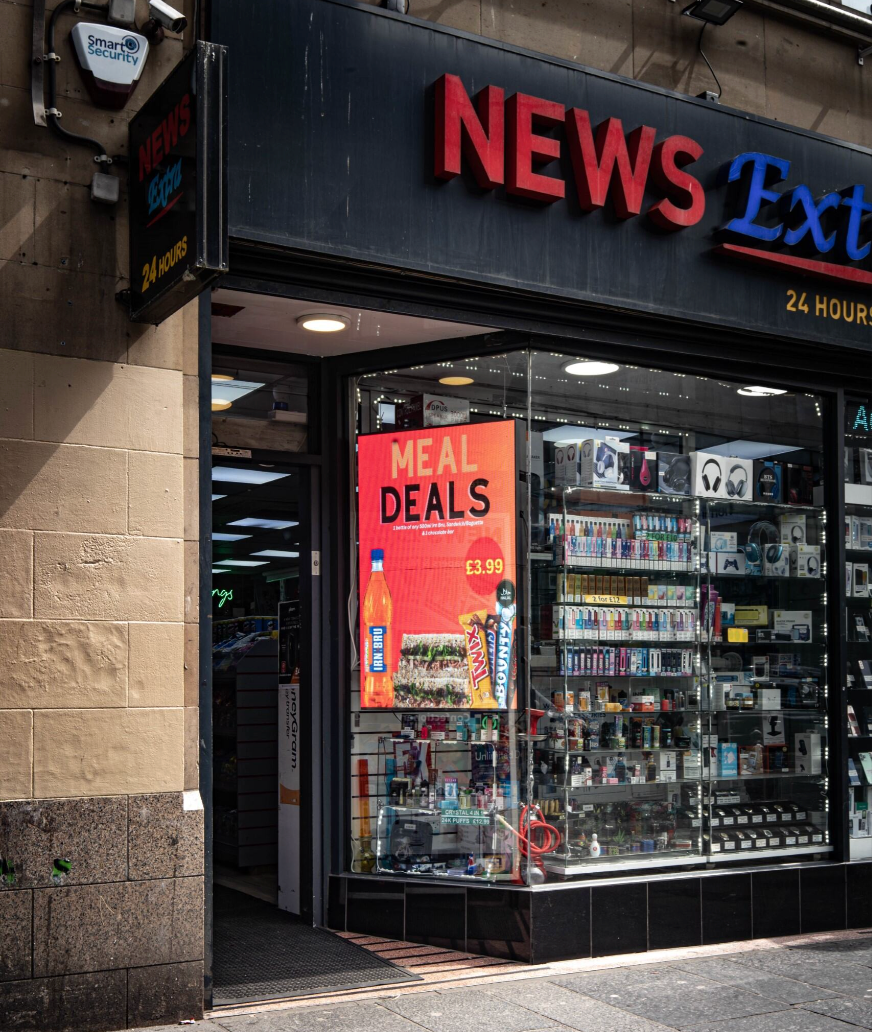
Shop windows are premium retail real estate, and most high-street retailers are underusing them completely. A well-placed window display running promotional content can engage passers-by before they've even decided to enter — but only if the screen can actually be seen from the pavement.
Standard commercial displays are not designed for window placement. They struggle with direct sunlight, washing out entirely during bright weather and rendering the content unreadable at the moment when foot traffic is at its highest.
This is where purpose-built solutions make a measurable difference. The Ultra High Brightness Window Displays from BuyDigitalSignage.co.uk are built specifically for this placement challenge, with brightness levels engineered to remain visible even in direct sunlight — the core problem that kills most window display strategies. Available in portrait sizes from 43" to 75", with pricing from £1,770, these are designed for estate agents, gyms, salons, and high-street retail locations where passive footfall is a primary acquisition channel.
The placement principle here is straightforward: position the screen so that it faces the direction of primary pedestrian flow, not simply outward from the window. On a high street where customers predominantly approach from the left, a screen angled toward that approach direction — even marginally — will engage more passing attention than one mounted perfectly perpendicular to the window frame.
Indoor Mount Strategy: The Variables Most Retailers Overlook
Inside the store, mount decisions are shaped by three variables that rarely appear on a digital signage checklist: ceiling height, fixture layout changes, and category adjacency.
Ceiling height determines the available vertical mounting range, but it also affects the perceived scale of a screen. A 43-inch display in a store with 2.8-metre ceilings reads very differently from the same screen in a space with 4-metre ceilings. Retailers with high ceilings often over-correct by choosing larger screens when the actual fix is mounting height — bringing the screen lower into the customer's field of view rather than increasing its size.
Fixture layout changes are where most indoor signage ROI quietly erodes over time. A screen mounted to display product content for a category that has since been relocated three metres to the left is now contextually irrelevant. Articulating and adjustable mounts allow for reorientation as the store evolves, which is why treating mount hardware as a throwaway purchase is a false economy.
For interior retail applications, the Slimline Digital Poster range offers a practical and well-specified option. Running on Android 11 with Ultra HD (4K) resolution and a brightness of 500 cd/m², these portrait displays are available from 22" to 55" with pricing from £410. The slimline form factor is genuinely useful here — a shallower profile reduces the risk of the screen becoming a physical obstacle in narrower aisle configurations, which is a practical constraint that rarely features in the "what screen should we buy" conversation but causes real problems post-installation.
Outdoor Placement: Weather, Angle, and Ambient Light
Outdoor retail digital signage introduces additional complexity around exposure and ambient conditions, but the fundamental placement principles remain consistent with indoor application — sightline, dwell, and angle.
The most common outdoor placement error is positioning screens where they receive direct sunlight during peak trading hours. Even high-brightness commercial displays will lose visual impact against direct sun glare, and customers approaching from a sun-facing direction will find the screen difficult to read. Angling the mount to take advantage of natural shading, or selecting a position where the screen faces away from the primary sun direction, consistently outperforms simply installing the largest available screen in the most prominent position.
For outdoor installations, the Outdoor LCD Displays range from BuyDigitalSignage.co.uk is built for commercial environments where weather exposure and sustained brightness are non-negotiable requirements. Available in portrait orientations from 22" to 65", with pricing from £1,435, these wall-mounted screens are designed for retail, hospitality, and public venue use where the display needs to perform reliably across varying lighting and weather conditions.
The principle that applies indoors applies equally here: a smaller screen mounted at the correct angle and height in a high-dwell outdoor location — a queue line, a covered entrance, a smoking area adjacent to a hospitality venue — will outperform a larger screen mounted at height on an exposed wall where customers pass quickly and rarely look upward.
Reframing the ROI Conversation: What "Working" Actually Looks Like
ROI from retail digital signage is rarely instantaneous, and it isn't measured purely in immediate sales uplift. The more useful frame is attention — specifically, how consistently your screens are capturing it at the moments that matter.
A display that customers genuinely look at is performing. One they walk past without registering is not, regardless of its specifications. The stores achieving the best results from their signage investments are the ones asking "where do our customers look, and how do we put our screen there?" before they ask "how big a screen do we need?"
That reframe — from screen specification to placement strategy — is the operational shift that separates retailers who are satisfied with their signage ROI from those who keep upgrading and wondering why the numbers aren't changing.
Before purchasing a larger screen, walk your shop floor during peak hours. Watch where customers slow down. Note where their eyes go naturally. Then decide where to put the screen — and what size actually fits that location. The answer is usually smaller than you'd expect, and closer to the customer than you'd think.
Browse the full range at BuyDigitalSignage.co.uk to find the right display for the placement you've identified — not the other way around.
FAQ
Q: Does screen size matter at all for retail digital signage, or is placement always more important? A: Screen size matters, but it should be determined by the viewing distance and available wall space at your chosen mount location — not selected first and then mounted wherever it fits. A correctly sized screen in the right position will consistently outperform an oversized screen in the wrong one.
Q: What's the recommended mounting height for retail digital signage in a standard shop? A: A general guideline is to centre the screen between 150cm and 170cm from floor level, which aligns with the average adult sightline during relaxed browsing. In dwell zones like till areas or fitting room corridors, you may adjust slightly based on whether customers are seated, standing, or moving.
Q: Are portrait or landscape orientations better for in-store retail displays? A: Portrait orientation is frequently more effective for in-store retail environments, particularly in tighter spaces. It mirrors human proportions, fits narrower wall sections, and tends to suit the vertical format of promotional content. Landscape works well for video-led content or wider horizontal display areas, such as above a service counter.
Q: Can standard commercial displays be used in shop windows? A: Standard displays are generally not suitable for shop window placement because ambient and direct sunlight significantly reduces their visibility during daylight hours. Purpose-built high-brightness window displays, such as the Ultra High Brightness Window Displays available from £1,770, are specifically engineered to remain legible in bright outdoor conditions.